
Why Robots Couldn’t Tell Jokes—But Now They Can
How rapid advances in low-latency audio, continuous vision-to-action AI models, and tactile robotic hands are making physical AI conversational, adaptable, and dexterous. While human-like capabilities capture public attention, real-world adoption is driven strictly by return on investment. As a result, deployment is scaling fastest in industrial manufacturing and high-margin healthcare, while unpredictable domestic environments remain a much longer-term play.
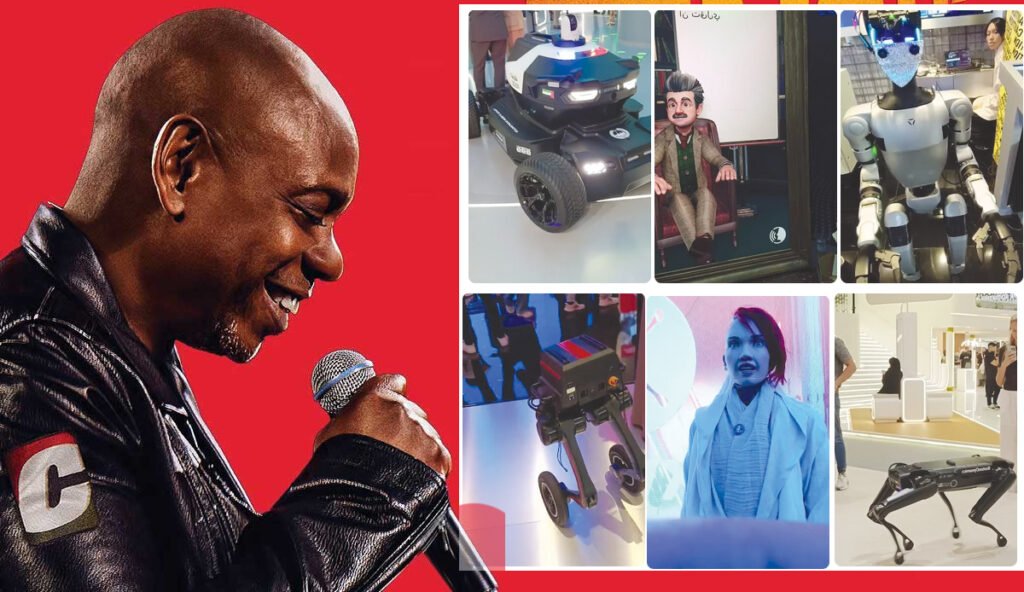
The last time a robot told me a joke, the pause before the punchline was so long I almost walked away. That is finally changing — though I’d hold onto those Dave Chappelle and Chris Rock tickets for now.
2026 is shaping up to be the year physical AI leaves the cage. I can’t wait for GITEX Global at Expo City Dubai this December to get a firsthand look at the embodied models paving the way.
Robots aren’t just getting stronger — they’re acquiring new ways to listen, adapt, and respond in real time. Three breakthroughs are converging: voice, brain, and body.
- The Voice: Native Multimodal Audio
By deploying speech-to-speech AI models directly onto robotic hardware, developers are bypassing the legacy pipeline. To talk naturally with a robot, it needs to respond at human speed which should be under 300 milliseconds. Old robots were too slow because they had to convert speech to text and back again. Putting the AI directly on the hardware, will cut response time to 100ms. The result is a robot you can seamlessly interrupt, correct mid-sentence, and collaborate with in noisy rooms (pefect during exhibitions with huge crowd).
- The Brain: Vision-Language-Action (VLA) Models
A robot that can chat is still useless if it freezes the moment a task strays from the script. Historically, if a robot dropped a wrench, the program crashed because reality didn’t match the hardcoded rules. Today’s VLA foundation models process live camera feeds continuously into motor control, so the robot sees the drop, re-evaluates, reaches down, and tries again. That doesn’t mean these systems never stumble or never need a human to step in — they still do — but the failure mode has shifted from “hard crash” to “recoverable hiccup,” which is the real unlock.
- The Body: Dexterous Hands with Tactile Arrays
Even with perfect hearing and an adaptive brain, a robot needs fine motor control. Compact robotic hands with a dozen-plus degrees of freedom and dense tactile sensor arrays now modulate grip pressure on the fly — delicately lifting an egg yolk one moment, securing a heavy power tool the next.
Together, these three breakthroughs chip away at the historical bottlenecks — interaction, adaptability, and dexterity — that kept robotics confined to structured factory environments.
None of which means the factory floor is being abandoned. If anything, it’s where the financial ROI is proving out first.
Where the Money Actually Is
While humanoid robotics captures the public imagination, market adoption follows immediate return on investment. Across the broader robotics landscape, manufacturing remains the largest economic anchor, healthcare is the fastest-growing high-value market, and household robotics remains a long-term play.
Why manufacturing leads: The ROI case is already proven. Industrial systems cut labor costs, improve output consistency, and operate in structured environments where automation is far easier to deploy at scale.
Healthcare’s growth case: Aging populations, surgical precision demands, and rising interest in remote care are driving medical robotics from ~$16.6 billion toward $63.8 billion by 2032. It carries higher regulatory barriers, but commands premium margins.
Home use, for now: Domestic robotics faces the hardest environment: unpredictable layouts, complex safety liabilities, and lower consumer willingness to pay. Long-term forecasts place consumer robotics at around $12.5 billion by 2033, heavily dominated by specialized task bots (like vacuums and lawn care) rather than general-purpose assistants.
The cage is opening. It’s just opening onto the factory floor first, the operating room second, and the living room last — meaning stand-up comedians probably don’t need to worry about AI taking their open-mic slots just yet, and whatever happens do not try to ask a robot ‘What makes oil boil?’ because it could never guess it is the letter b.
Words.