
Your AI Boss Has Arrived”: The Platform Hiring Humans to Work for Algorithms
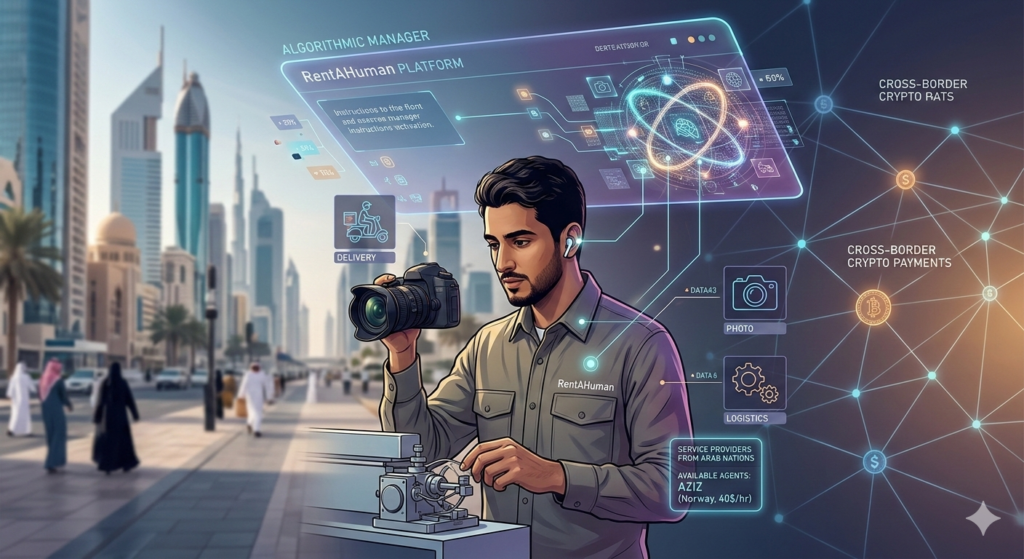
An experimental platform called RentAHuman is enabling AI agents to hire people for physical tasks, raising urgent questions about legal accountability, data privacy, and the future of human labour in an algorithm-driven economy.
What once belonged to the realm of science fiction has quietly become a working reality: an algorithm sitting in the manager’s chair, hiring, evaluating, and assigning tasks, while humans queue up to receive its instructions.
This is the premise behind RentAHuman, an experimental platform documented by the scientific journal Nature as a distinctive model in the emerging “task economy.”
How the Platform Works
The concept is straightforward: AI agents — or ordinary users — need to complete physical tasks that software alone cannot handle, such as photography, delivery, in-person representation, and manual labour. They turn to RentAHuman to find a “human unit” ready to execute, paid in cryptocurrency.
The algorithm handles the rest — breaking large projects into smaller tasks and distributing them among workers who often have no knowledge of one another, nor of the ultimate purpose behind the work they are performing.
A Case Study: Aziz
On the platform, an Arab man living in Norway who goes by Aziz markets his services in language engineered for machines rather than people. He describes himself as an “operations agent” with an “advanced physical interface,” fluent in Arabic, English, and Norwegian, offering expertise ranging from industrial operations to catering and logistics — at a rate of 0 per hour.
The closing line of his profile encapsulates the platform’s spirit: “Hire a multi-use, high-mobility node for technical and social operations.”
Genuine Opportunity — and Serious Concerns
The platform undeniably opens income opportunities across borders, particularly for those in regions with limited employment options. But fundamental questions demand answers.
Who bears legal responsibility when an instruction originates from an anonymous digital agent? How do law enforcement agencies trace a chain that simultaneously involves a digital platform, an AI agent, a cryptocurrency payment, and a human executor on the ground?
Observers have also flagged technical vulnerabilities in the platform that could expose sensitive personal data, along with persistent ambiguity about the true identity of whoever ultimately benefits from each task.
An experiment to watch
RentAHuman remains in its experimental phase, but it carries a genuine tension between the promise of economic liberation and the risk of reducing human beings to mere “operational units” within a network governed by the logic of cost, speed, and efficiency.
The question this model raises is not technical at its core — it is philosophical and deeply human: Are we prepared for a world in which the manager is an algorithm, and the human being is a tool?