
Design That Endures
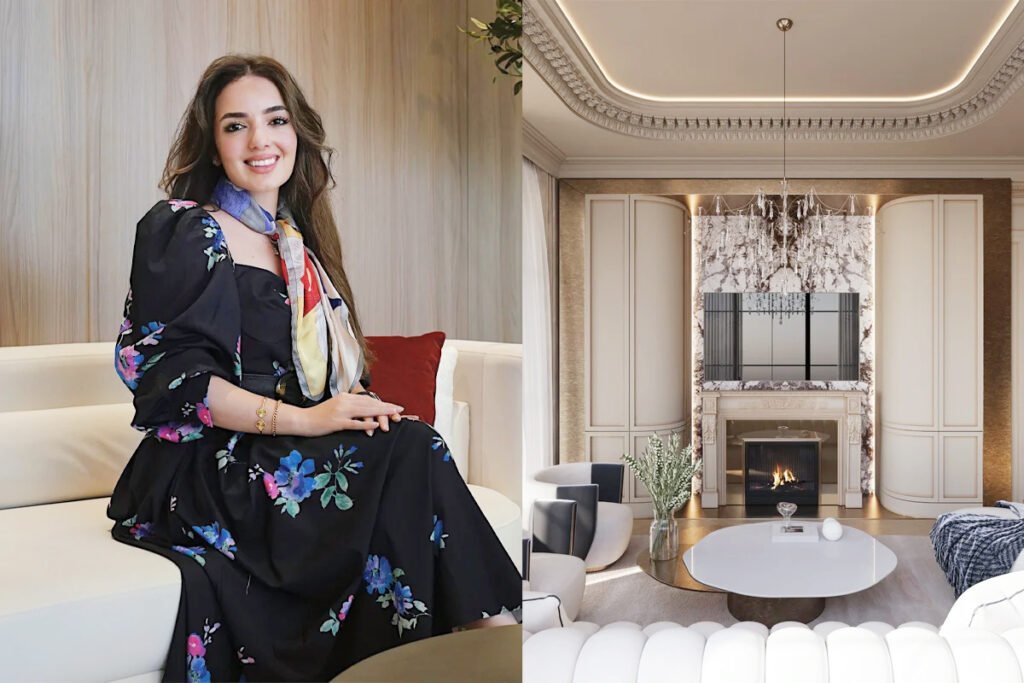
From exploring the quiet role of AI in design to redefining luxury as durability and emotional balance, Kapour’s philosophy centres on one idea: true design is the translation of personality, not trend. Each detail has purpose; each room feels inevitable.
Vanola Studio’s Ola Kapour on timeless interiors, the quiet power of AI, and why every great room begins with a personality — not a trend.
In a city where skylines shift overnight and global trends arrive before they’ve even left the runway, Vanola Studio has built something rare: a reputation for calm. Based in Dubai, the interior design practice led by CEO Ola Kapour operates on a different frequency to the frenetic churn of seasonal aesthetics. For Vanola, a space isn’t finished when it looks beautiful — it’s finished when it feels inevitable.
Kapour speaks about design the way a sculptor might: with patience, precision, and a deep resistance to decoration for its own sake. ‘Design isn’t about arranging furniture,’ she says. ‘It’s a subtle translation of lifestyle — where luxury meets simplicity, and where technology becomes a quiet tool that enhances creativity rather than dictates it.’
AGAINST THE CURRENT
The interior design industry has not been immune to the pressures of fast fashion. Trends cycle through showrooms with the same velocity as apparel, and clients — particularly in a cosmopolitan hub like Dubai — are often exposed to an overwhelming volume of competing aesthetics. Vanola’s response is deliberate restraint.
“We don’t get swept away by fast fashion. We observe it calmly and analyse it before adopting any element. We take what can last for years and steer clear of anything temporary or flashy.”
What clients request most, Kapour notes, are spaces that are visually simple, flexible in use, and capable of evolving over time without requiring wholesale reinvention. Comfort and adaptability have overtaken spectacle as the primary brief — a shift she welcomes.
THE QUIET ROLE OF ARTIFICIAL INTELLIGENCE
Few topics have generated more noise in the creative industries over recent years than artificial intelligence. For designers, the questions are pointed: can a machine understand atmosphere? Can it grasp the way light falls differently in a room depending on how its occupant moves through it?
Kapour’s answer is nuanced, and worth hearing in full. Vanola does use AI — but carefully, and only in the supporting act.
“We use artificial intelligence as a supporting tool in technical and organisational stages, such as accelerating analysis or exploring options. But it doesn’t drive the design process. Creativity is linked to feeling, experience, and understanding the relationship between people and space. AI helps us work smarter, but it doesn’t replace human insight or creative decision-making.”
‘Value will lie in taste and decision-making — not in the quantity of tools.’
On the question of what AI cannot do, Kapour is similarly clear. A client’s personality, she explains, isn’t understood through a questionnaire. It emerges through observation — the details they linger on, the way they move through a space, the things they don’t say as much as those they do.
‘We dedicate ample time to this stage and build a relationship based on trust and privacy. For us, design is a subtle interpretation of personality, not a ready-made template that can be applied to everyone.’
As for the designer’s evolving role in an AI-enabled decade, Kapour sees transformation rather than displacement. ‘The designer’s role will evolve, not diminish. It will become more selective and conscious — choosing from technology what serves the idea, and discarding what distracts from it.’
THE GRAMMAR OF SOPHISTICATED SIMPLICITY
Vanola’s visual language sits in a precise and demanding register: luxurious without ostentation, simple without bareness. Achieving this balance requires not just aesthetic judgment, but philosophical honesty about the purpose of every element in a room.
“Luxury becomes tiresome when it turns into ostentation, and simplicity loses its value when it lacks soul. The fine line between them is balance and honesty in choice. We always ensure that every detail has a purpose, and every material plays a clear role in the overall aesthetic.”
This philosophy extends to colour. Kapour is known for pointing out that ‘not all white evokes the same feeling’ — a seemingly small observation that contains a great deal of practical wisdom. ‘Shades of white vary greatly, and each has its own distinct feel. Warm or cool undertones, combined with the type of lighting, can completely transform the atmosphere. Choosing the wrong tone can make a space feel cold or oppressive.’
On materials, the studio applies an equally rigorous standard. ‘We always look for materials that are durable and improve with use. We prefer natural and practical materials that maintain their beauty without complex maintenance. For us, true luxury is lasting — not just initial glamour.’
DUBAI’S DIVERSITY AS A DESIGN ASSET
Vanola’s team is deliberately multinational — and Kapour credits this directly for the studio’s distinctive visual identity. In a city as culturally layered as Dubai, understanding the breadth of client backgrounds isn’t optional; it’s the work itself.
“The multinational backgrounds of our engineers and designers have helped us understand clients from different backgrounds and learn about diverse ways of thinking and lifestyles. This diversity has allowed us to create a unique style that is not widely seen in Dubai, and this has truly helped us stand out.”
The non-negotiable principle beneath all of it, she adds, is deceptively simple: a home should reflect its inhabitants. Not a trend. Not a designer’s signature. The people who live there.
THE ART OF KNOWING WHEN TO STOP
Perhaps the most revealing insight into Vanola’s design philosophy comes not from what they add to a space, but from how they know when to stop. It is, in many respects, the hardest discipline in design.
“When we reach a point where adding or removing any element would disrupt the balance, we know the design is complete. Simplicity here isn’t a deficiency — it’s a perfection.”
The same principle governs their approach to small spaces, where the temptation to over-specify is strongest. ‘We rely on unified flooring to create a sense of spaciousness and choose carefully considered lighting rather than cluttering it. Hidden storage plays a significant role, as does using mirrors in strategic locations. The goal is always to maintain functionality while keeping the space visually light.’
Design, Kapour insists, is not the assembly of beautiful elements. It is the creation of a harmonious whole that serves everyday life — a distinction the industry frequently forgets.
A STUDIO THAT SPEAKS FOR ITSELF
Asked what Fanola Studio would look like if it were a single room, Kapour describes it without hesitation. ‘A calm and confident presence. Warm neutral colours, natural materials, and few but carefully considered details. A personality that doesn’t impose itself forcefully, but leaves a distinct impression.’
That room, she notes, already exists. Visitors to the Dubai studio consistently leave with a sense of having experienced something genuinely singular — a space that is, in the truest sense, designed.
Vanola Studio | vanola.ae