When It Rains, Jubail Island Listens: The Infrastructure Quietly Redefining Abu Dhabi’s Relationship with Nature
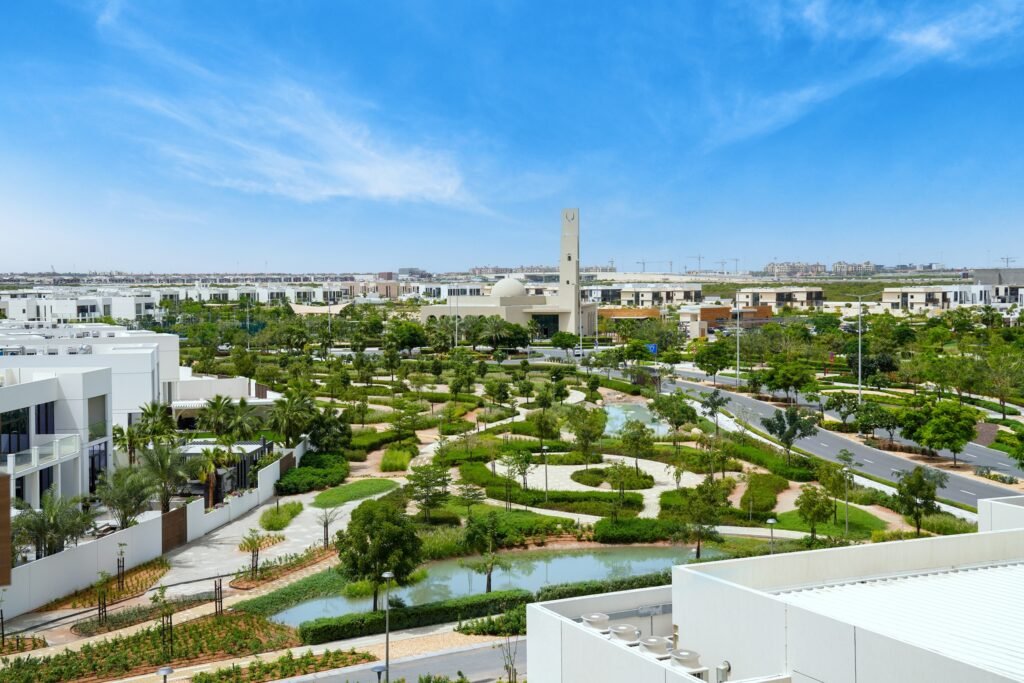
From retention ponds hidden in public parks to groundwater quietly recharging beneath the surface, Jubail Island's water system makes a simple argument: the best infrastructure is the kind that works before anyone notices it needs to.
Tucked between Yas Island and Saadiyat, Jubail Island’s water management system turns seasonal rainfall into a long-term environmental asset — and makes the case that the most important infrastructure is often the kind you can’t see.
Most developments treat rain as an inconvenience to be managed and dispatched as quickly as possible. Gutters, drains, runoff — the engineering vocabulary of rainfall is overwhelmingly about removal. Jubail Island, LEAD Development’s flagship nature-led community in Abu Dhabi, is working from a different premise entirely: that rain is a resource, and that the infrastructure built to handle it should behave accordingly.
As the UAE experienced seasonal rainfall this week, the island’s integrated water management system moved from blueprint to proof point — demonstrating in real time how thoughtfully designed infrastructure can turn a weather event into an environmental dividend.
HOW THE SYSTEM WORKS
Rather than relying on conventional drainage to funnel water away from the site, Jubail Island’s approach centres on a network of retention ponds embedded throughout the island’s parks and public spaces. These are not decorative water features that happen to collect runoff — they are functional components of a live hydrological system, engineered to work in concert with the island’s natural terrain.
During periods of heavy rainfall, the ponds collect surface runoff, reducing the risk of flooding while simultaneously relieving pressure on traditional drainage infrastructure. Over time, that retained water is gradually absorbed into the ground, supporting groundwater recharge and feeding the island’s native vegetation — including its surrounding mangrove ecosystem.
Jubail Island — Key Facts
- Over 40 million square metres in total area
- Located between Yas Island and Saadiyat Island, Abu Dhabi
- Developed by LEAD Development under Jubail Island Investment Company (JIIC)
- Low-density master plan preserving natural mangrove habitats
- Home to Jubail Island Mangrove Park, Abu Dhabi Royal Equestrian Arts, Spinneys and Souk Al Jubail
- Water system reduces reliance on treated irrigation water
INFRASTRUCTURE AS ECOSYSTEM
What makes Jubail Island’s approach notable is not any single piece of engineering — it is the underlying design logic. The retention ponds are integrated into parks and communal spaces, meaning they serve the community aesthetically and experientially, not just functionally. Residents do not encounter a utilitarian drainage basin; they encounter a landscape that visibly responds to its environment.
“When it rains, you can truly see how Jubail Island works with nature, not against it.”
— LEAD Development
That phrase — working with nature, not against it — is easy to invoke and genuinely difficult to operationalise. Here, at least, the infrastructure makes the claim legible. The system reduces dependence on treated irrigation water, supports the island’s mangrove ecosystem, and enhances the visual and experiential quality of the public realm, all within a single integrated design. The benefits compound rather than compete.
A BROADER SHIFT IN ABU DHABI DEVELOPMENT
Jubail Island’s water system is also a signal of something happening at a larger scale across Abu Dhabi’s real estate sector. As climate resilience moves from aspiration to expectation, developers are increasingly being asked to demonstrate not just that their communities are sustainable in principle, but that the infrastructure embedded in them actually performs under real conditions.
The UAE’s seasonal rainfall events — increasingly scrutinised since the April 2024 storms that exposed drainage vulnerabilities across the region — have sharpened that scrutiny considerably. A water management system that functions visibly and effectively during a rain event is no longer a nice-to-have; it is becoming a baseline expectation for any development positioning itself as future-ready.
LEAD Development’s broader portfolio reflects a similar orientation. With projects including Hidd Al Saadiyat, Emirates Palace, and Waldorf Astoria DIFC alongside national-scale housing initiatives, the company operates across a range of development contexts — but Jubail Island is where the sustainability thesis is most fully expressed.
THE HARDER QUESTION
Communities built around low-density planning, preserved habitats, and wellness-focused design are increasingly common as a category. What separates rhetoric from reality is almost always infrastructure — the systems that operate invisibly until they are tested, and that reveal, when tested, whether the development’s values were built in or bolted on.
On the evidence of this week’s rainfall, Jubail Island’s water system appears to be the former. The ponds collected. The ground absorbed. The mangroves were fed. The residents noticed — and in the right way: not because something went wrong, but because something quietly, deliberately went right.
That, in the end, is what climate-conscious development actually looks like. Not a sustainability report. A system that works when it rains.
jubailisland.ae | leaddevelopment.ae